
The role of magnetic fields in the Galactic Center
Molecular clouds are the primary sites of star formation, with stars forming in their densest regions. A nearly universal relation has been established between the star formation rate (SFR) and the mass of dense gas, both in Galactic molecular clouds and in external galaxies (e.g., Gao & Solomon; Lada et al. 2010). However, in the innermost 150 pc of the Milky Way, the Central Molecular Zone (CMZ), the current SFR is about an order of magnitude lower than predicted by this dense gas–star formation relation (Longmore et al. 2013; Barnes et al. 2017). We found that magnetic field plays a key role in affecting star formation in the CMZ.
The role of magnetic field in molecular clouds in the Galactic Center
In our study (Pan et al. 2025), we applied the Histogram of Relative Orientation (HRO, Soler et al. 2013) method, which quantifies the alignment between magnetic fields and column density structures. Applying the HRO analysis to the magnetic fields of CMZ clouds, we find that the relative orientation between magnetic fields and column density structures is random in low-density regions, but becomes preferentially parallel in high-density regions. This trend is in contrast with that of the Galactic molecular clouds, where the relative orientation transitions from parallel to perpendicular with increasing column densities. We propose that the origin of this preferred alignment lies in the super-virial, non–self-gravitating nature of most CMZ dense structures, where strong turbulence and magnetic fields dominate over gravity.
These results provide statistical evidence that magnetic fields in the CMZ shape dense gas differently than in the Galactic disk. By showing that strong turbulence and magnetic support inhibit gravitational collapse, this work presents a key factor behind the CMZ’s unusually low star formation rate, offering a new perspective on star formation under extreme Galactic-center conditions.
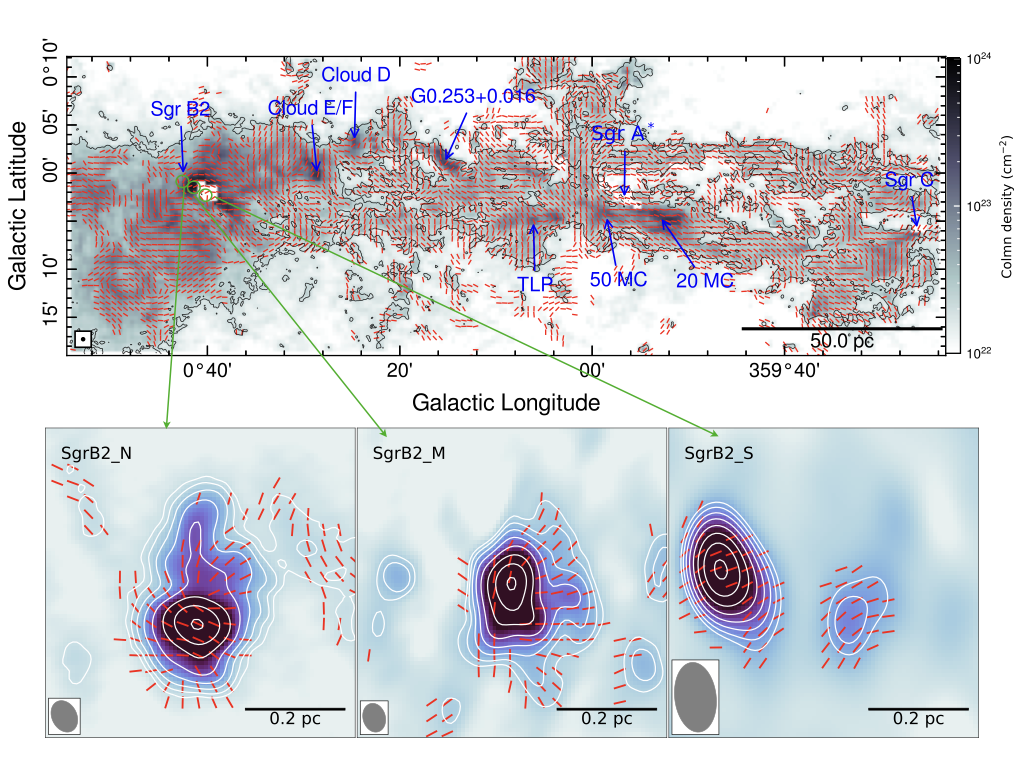
Top: Magnetic field orientations across the CMZ, with red segments showing plane-of-sky fields from SOFIA/HAWC+. Bottom: Magnetic field morphologies in three active star-forming regions within Sgr B2 observed by SMA.
Magnetic fields of massive dense cores within CMZ clouds
Even though the CMZ shows a global suppressed star formation activities, some molecular clouds still have active star formation, in agreement with the dense gas-star formation relation. With its high star formation rate and efficiency, Sagittarius B2 (also known as Sgr B2) hosts one of the most active star forming regions in our Galaxy, mimicking external starburst galaxies (Motte et al. 2003).
In my recent work (Pan et al. 2024), we present the first arcsecond-resolution (<0.1 pc) maps of magnetic field morphologies in three actively star-forming cores, Sgr B2(N), Sgr B2(M), and Sgr B2(S), using SMA observations. Our analysis of the energy balance between magnetic fields, gravity, and turbulence shows that gravity overwhelms magnetic support in all three cases, consistent with the mini-starburst nature of Sgr B2. Comparison with quiescent regions in the CMZ (e.g., G0.253+0.016; Pillai et al. 2015) shows that magnetic fields play a significant role in regulating star formation, with their influence varying across different environments. Extending this to other Galactic mini-starburst regions such as W43 and NGC 6334, our multi-scale studies suggest that maintaining supercritical conditions (gravity overpowering magnetic fields) across spatial scales may be a key factor for triggering intense star formation.