
Accretion disks around massive protostars
As dense cores continue to collapse, circumstellar disks naturally form from infalling material under the influence of gravity and the redistribution of angular momentum through torques (Turner et al., 2014). While disks around nearby solar-type stars have been extensively studied in their structures, evolutions, and roles in planet formation (e.g., Ansdell et al. 2016, 2018; Andrews et al. 2018), the formation, properties, and role of disks around more distant and massive stars remain far less understood mainly due to the limited detections of such disks.
To explore the picture of disks around massive protostars, my recent work (Pan et al. 2024; 2025) have established a survey of a large sample of massive dense cores (MDCs, the size of a few 0.1 pc, masses of 10-100 solar masses) within a giant molecular cloud, Cygnus X. Our findings suggested that disks around massive protostars are typically several hundred au in size. The absence of Keplerian signatures in the other candidates demonstrates that rotation detected at about 2000 au does not necessarily imply the presence of compact disks.
Large (2000 au scale) disk candidates revealed by SMA (Pan et al. 2024): 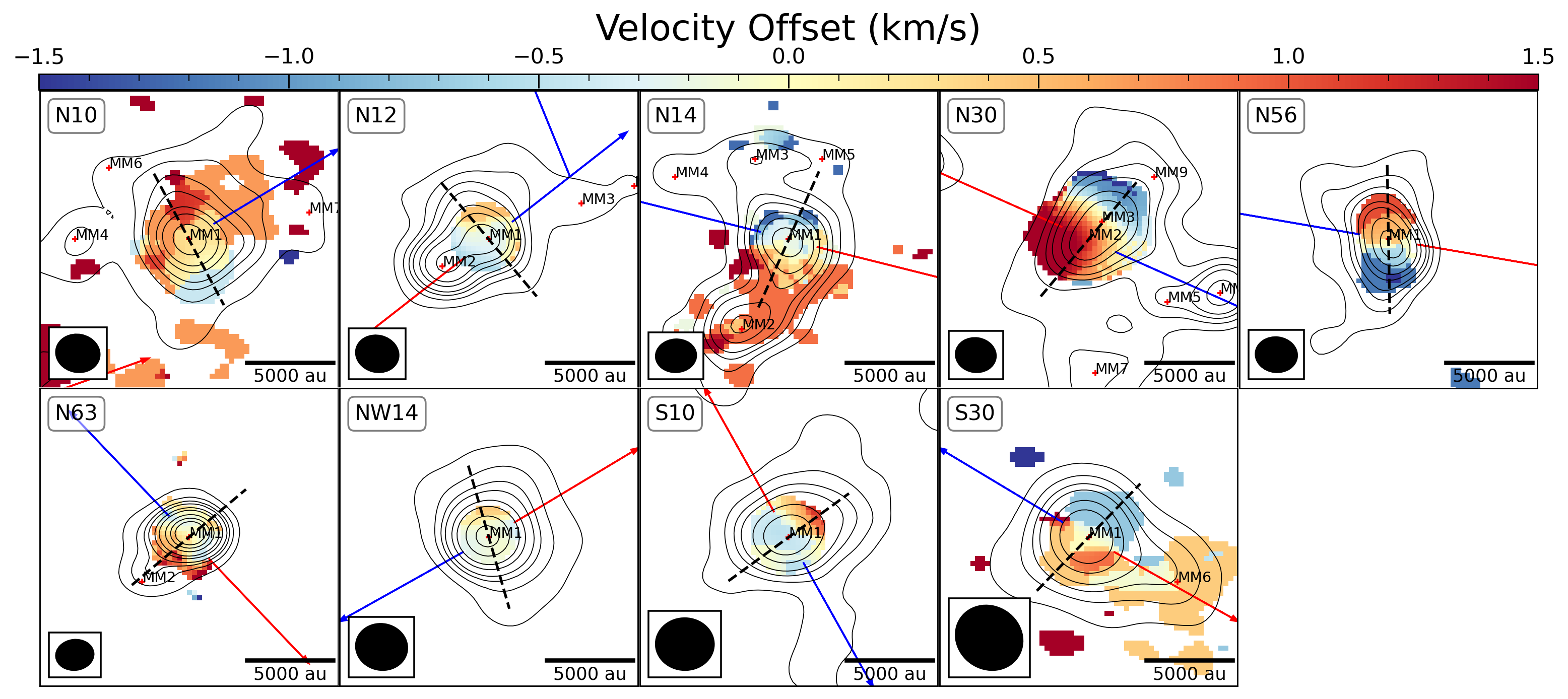 Gas kinematics surrounding massive protostars revealed by dense gas tracers. Red/Blue arrows represent axis of red-/blue-shifted outflow, respectively.
Zoom in view of the disk candidates observed by NOEMA (Pan et al. 2025): 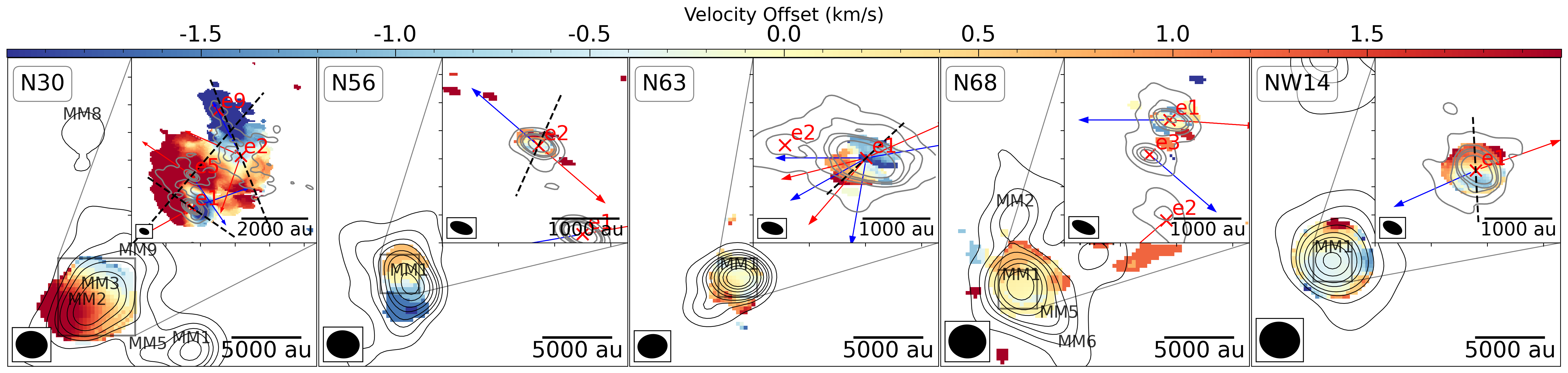 Gas kinematics surrounding massive protostars revealed by dense gas tracers. Red/Blue arrows represent axis of red-/blue-shifted outflow, respectively.